
Masoud Owji: Finding Healing and Acceptance Through Running

In 1998, at the age of only 17, on an unassuming night out with friends, Masoud Owji’s life changed forever. He was badly burned in the Gothenburg discotheque fire, a disaster that tragically claimed the young lives of 63 of his friends and neighbors. Nearly 20 years later, Masoud’s life changed again — this time, for the better, when he fell in love with distance running.
This April, he will run his sixth Abbott World Marathon Major, the 130th Boston Marathon, for The Gillian Reny Stepping Strong Center for Trauma Innovation, completing his “six star” journey.
A New Normal
Masoud doesn’t remember the fire. He only remembers waking up two months later, unaware of what had happened. He had suffered injuries so severe that doctors had to sedate him and place him in an induced coma.
“Waking up from the coma wasn’t like waking up from sleep,” Masoud says. “The medication was tapered so gradually that I came to for maybe an hour the first time, then a little longer each time after. I had been in such a deep dream state that when reality started to emerge, my dreams and waking life floated into each other. I couldn’t distinguish what was real. It was horrific.”
When Masoud finally understood what had happened, after his family explained the fire and the friends he had lost, he couldn’t even respond — a tracheostomy tube rendered him unable to speak. “In those early days, the only way I could communicate was by blinking my left eye: once for yes, twice for no.”
“I had also lost an enormous amount of body mass,” he says. “Before the accident, I weighed around 180 pounds — I was stocky, I did a lot of weightlifting and biking,” Masoud says. “After about two and a half months, I was down to roughly 100 pounds. I was pure bone and skin. I couldn’t speak, couldn’t sit up, couldn’t stand.” Masoud lost his left arm just below the elbow, four fingers on his right hand, his left eye, and had severe burns over 30% of his body.
It took about a year of rehabilitation before he could take his first steps. And now, 27 years later, Masoud is running his sixth major world marathon.
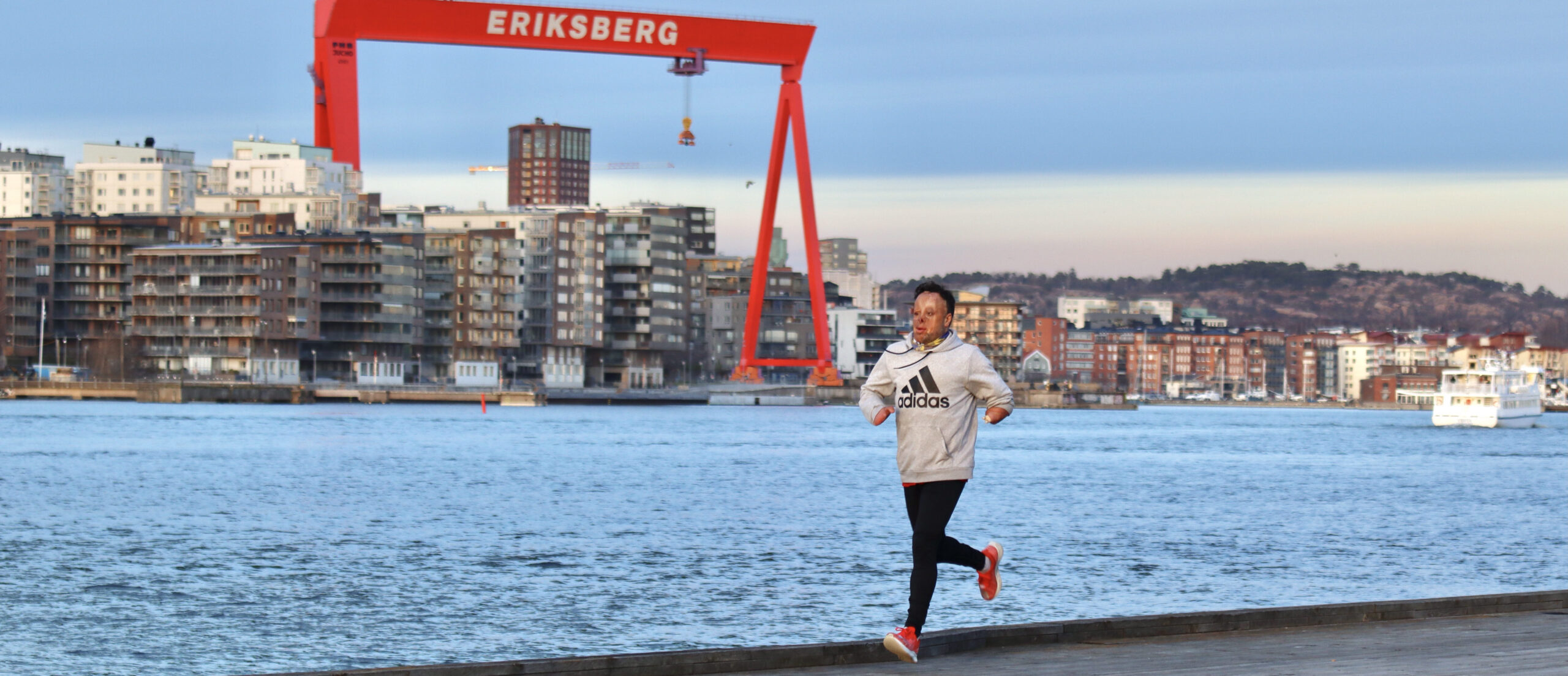
Finding Community Through Running
Finding distance running has transformed Masoud’s life, offering him a space to think and a sense of calm and purpose. “Running has transformed my mindset,” Masoud says. “Day to day, I’m just so much more at peace than I used to be.”
Running has granted him membership in a global community of marathoners and endurance athletes that has led him to new people and places and that has connected him with organizations like the Stepping Strong Center, where he’s been introduced to so many who deeply understand his journey of trauma and recovery.
Fundraising for the Stepping Strong Center has exposed Masoud to many stories like his and to the groundbreaking research and patient care taking place at the center — including innovations that would have greatly improved his quality of life 27 years ago. Now, he is helping to ensure they are accessible to future trauma patients.
I know firsthand the pain, the struggle, and the courage it takes to survive a life-altering trauma. Supporting Stepping Strong means giving hope, care, and opportunity to people who, like me, have faced devastating injuries and are working to reclaim their lives.
“The truth is, life is hard,” Masoud says. “Managing daily life with the physical damage from my injuries is so much harder than people probably imagine. You have to accept that ‘this is how it is,’ and that’s a hard threshold to pass. With time, anything becomes normal. I can’t point to a single moment where it clicked — there were plenty of small ones along the way.”
Even though running didn’t come into the picture until decades after the fire, it has been instrumental in helping Masoud reach healing and acceptance. His first road race was the Göteborgsvarvet (“Gothenburg Lap”), the world’s largest half marathon that takes place right in Masoud’s hometown — a full circle moment.
“Running helps enormously,” he says. “When something feels impossible, I go for a run and my mind opens up — suddenly I find a solution I couldn’t see before.” Not only does running provide a physical release, but it shows Masoud all he is capable of, despite all he’s gone through.
Masoud learned about the Stepping Strong Center through one of his doctors when searching for the right Boston Marathon charity team. “When I read about the Stepping Strong Center, I thought, ‘This is a perfect match,’” he says. “The story behind their work touches everyone. I’m proud to be part of it, and I’m really looking forward to meeting the team in person the Saturday before the race.”
“I know firsthand the pain, the struggle, and the courage it takes to survive a life-altering trauma,” he says. “Supporting Stepping Strong means giving hope, care, and opportunity to people who, like me, have faced devastating injuries and are working to reclaim their lives.”
To support Masoud’s Boston Marathon for the Stepping Strong Center fundraiser, click here.