
Turning Loss into Hope
One family's journey through cardiomyopathy

Jenn Capshaw remembers the stories of her great uncles dying months apart of sudden heart attacks in their 40s, and a decade later, of her grandfather also dying of a heart attack in his early 50s. The family’s losses continued when Capshaw’s own father died at 35, 18 months after being diagnosed with cardiomyopathy, a disease of the heart muscle. The family attributed these shared tragedies to a series of bad luck.
But 25 years later, in 2012, Capshaw’s family discovered a medically explainable connective thread to the untimely deaths; her uncle Kevin underwent genetic testing at Brigham and Women’s Hospital while experiencing end-stage cardiomyopathy and learned he carried a mutation to the LMNA gene, which causes a genetically inherited form of the disease.
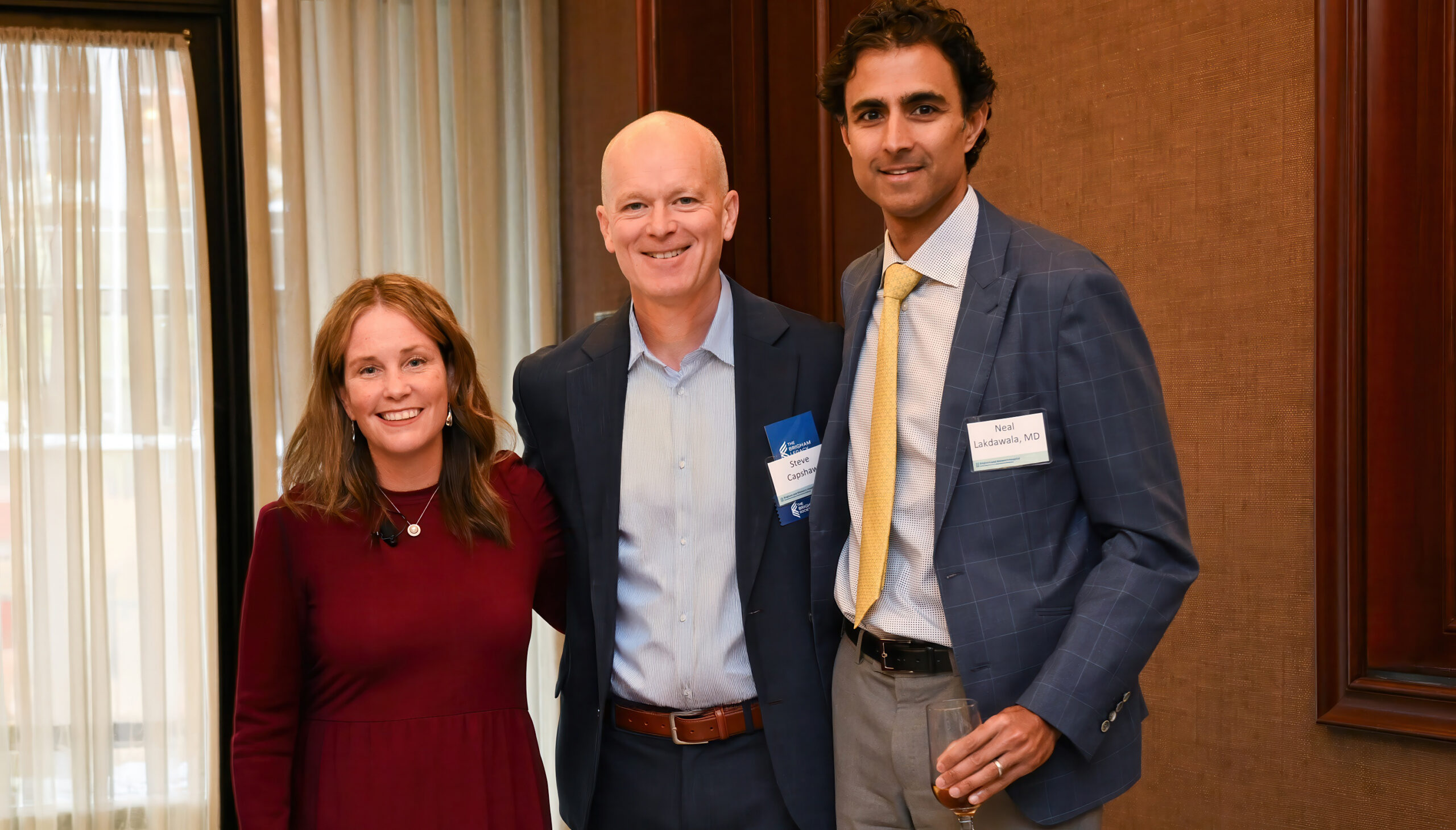
A few months after her uncle’s death, Capshaw and several family members met with his doctor, Neal Lakdawala, MD, director of the Cardiovascular Genetics Clinic at the Brigham, to discuss genetic testing and receive baseline assessments. An EKG that day revealed that Capshaw likely carried the gene, and subsequent testing confirmed it.
“It’s been 13 years since that first caravan to Boston, and this is where the story changes,” says Capshaw. “Thanks to the Brigham, our [family] legacy is now one of hope and not tragedy.”
Turning Loss into Hope
Hear Jenn Capshaw share her family's story.
Under Lakdawala’s care, Capshaw, an active mother of three, is doing well; she has a pacemaker and defibrillator, and takes medication to mitigate the risk of stroke.
The same could be said for Capshaw’s father’s cousin, Jerry. He was facing a diagnosis of end-stage cardiomyopathy at age 55, but received a heart transplant at the Brigham in 2019 and is thriving today.
In fact, identifying the gene mutation was critical to ensuring the best care, Lakdawala notes. “Things like cardiac arrest and stroke are fully preventable with applying this genetic diagnosis,” he says. “I told them, ‘Your family doesn’t need to continue to experience the kind of tragedy it has endured.’”
Knowing I’m connected to the expert care at the Brigham is a game-changer.
Inspired to give back
Grateful for the lifesaving care they have received, the family established the O’Hare Family Cardiovascular Research Fund to support groundbreaking research under the leadership of Lakdawala.
“In just 10 years, we have seen real, tangible promise and hope,” Capshaw says.
Support the Heart and Vascular Institute
Your gift will help advance expert heart and vascular care and groundbreaking research.
Donate now
Lakdawala points to progress that has resulted from this support. For example, he and his team were able to get closer to understanding the inner workings of how the LMNA gene mutation causes cardiomyopathy. They measured and analyzed proteins in people who have the mutation, then compared them with proteins in people who have other forms of cardiomyopathy. Isolating the protein in people with LMNA heart disease provided insight into possible ways the disease progresses.
In addition, the family’s philanthropy has helped back clinical research studies that have fueled better care for people with genetic cardiomyopathy, including identifying which patients would benefit from implanted defibrillators or specialized pacemakers. And it has paved the way for upcoming novel gene therapy clinical trials for LMNA heart disease.
“Their support has been really central and crucial for everything we’ve done and catalyzed many of the advances we’ve seen and continue to see,” says Lakdawala.
Patrick Ellinor, executive director of the Mass General Brigham Heart and Vascular Institute, sees the broad implications of the family’s support. “We are grateful for the collaborative research and clinical care empowered by their generosity, and foresee the next stage of groundbreaking treatment and therapies that will be possible in genetics-informed care,” says Ellinor.
These breakthroughs have motivated Capshaw to do even more; she and her husband, Steve, were recently inspired to name Mass General Brigham in their estate plans.
“Mass General Brigham has given me hope, care, and expertise that is truly world-class,” Capshaw says. “They’re not only treating patients like me but leading research that will change and save lives for generations to come.”
Capshaw notes that while her children don’t yet know if they carry the LMNA gene mutation, thanks to the ongoing research led by Lakdawala and his team, the future is bright.
“It is our way of turning something that has caused so much loss into something that creates hope,” Capshaw says.
To learn more about including the Brigham in your estate plans, please contact Kathleen Duffy, assistant vice president of gift planning, at giftplanning@bwh.harvard.edu or 617 424 4326.